GPT-6 Astra vs. Fable 5.1 for AI Agents: Which Model Wins?
Both models charge the same list price. What you actually pay depends on your agent's task shape, not the rate card.

- 01Astra excels at scoped, execution-heavy tasks like computer use and document generation.
- 02Fable 5.1 is better for long-running, cache-heavy agent loops and open-ended reasoning.
- 03Fable 5.1 charges 75% less for cache reads, saving money on repetitive agent loops.
- 04Astra uses fewer output tokens, making it cheaper per completed task for short runs.
- 05Astra's pricing doubles past 272,000 input tokens, while Fable 5.1 has no surcharge.
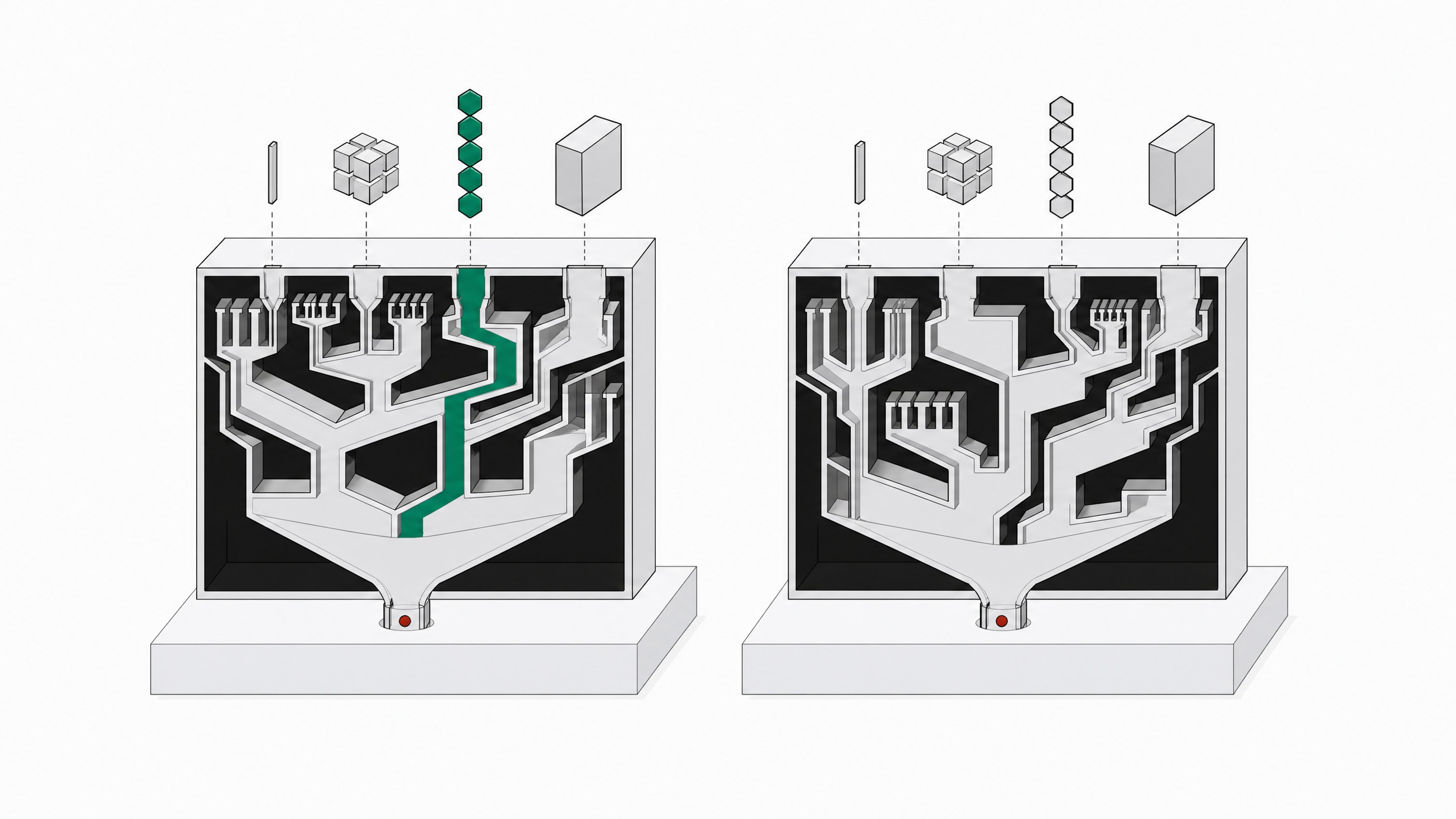
GPT-6 Astra is the better default for scoped, execution-heavy internal agents like computer-use tasks and document generation. Claude Fable 5.1 wins for long-running, cache-heavy agent loops and open-ended reasoning work. Neither model is better, full stop. The right pick depends on what your agent actually does all day.
Why do identical price tags produce such different bills?
GPT-6 Astra and Claude Fable 5.1 list at exactly the same API rates: $10 per million input tokens and $50 per million output tokens.12 Stop at the rate card and you'd conclude the decision doesn't matter. It does, because the sticker price hides two things that diverge sharply in practice: how many tokens each model burns to finish a task, and how each model prices cache reads.
Cache reads are the one line item where the cards actually differ. Fable 5.1 charges $0.25 per million cached tokens. Astra charges $1.00, rising to $2.00 once a request crosses 272,000 input tokens.1 That's a 4x-to-8x gap, and it only matters if your agent's spend is dominated by replaying cached context rather than generating fresh output. For a lot of internal agents, it is.
What GPT-6 Astra actually changes for agents
Astra acts more like a self-directed operator than a chat assistant. It decides on its own when to ask a clarifying question versus proceeding on its own judgment, and in Codex it keeps searchable notes across context windows instead of collapsing history into a lossy summary.31 OpenAI reports Astra's misaligned-outcome rate in realistic work environments at 3.4%, down from 18.8% for its predecessor GPT-5.6 Sol.1
That autonomy pays off on the tasks internal agents get built for. Astra scores 72.6% on OSWorld 2.0, a computer-use benchmark, while taking roughly 47% less time per task than Sol.4 It saturates FrontierMath Tier 4 at 97.6%, well ahead of Fable 5.1's 87.8%.1 And it beats Fable 5.1 on Terminal-Bench Science, 64.6% to 52.6%, at what OpenAI estimates is roughly 31% lower API cost for that task.3 If your agent's job is to click through a CRM, fill out a form, or produce a polished document artifact, this is the profile you want.
What Fable 5.1 actually changes for agents
Anthropic's headline change with Fable 5.1 isn't a new capability tier. It's a pricing mechanic that happens to reward exactly how agent loops behave. The company cut cache-read pricing by 75%, from $1.00 to $0.25 per million tokens, and estimates this lowers real costs by roughly 25% on typical workloads and up to 45% on highly agentic ones that keep replaying a large, stable context.567
That last clause matters. An agent loop that re-reads the same repo, the same system prompt, and the same tool schema on every step is precisely a highly agentic, cache-heavy workload. One Reddit thread from a practitioner running long agent loops found the total bill barely moved between Fable 5 and Fable 5.1 on a single short task, dropping only about 7.5%, but noted that cache reads dominate the bill on any long-running loop, which is where the discount actually shows up.8
Fable 5.1 also picked up real ground on reasoning and agentic-science benchmarks. Terminal-Bench-Science 0.1 more than doubled, from 24.7% to 52.6%.67 On Humanity's Last Exam with tools, a benchmark for broad, tool-augmented reasoning, Fable 5.1 scores 65.0% against Astra's 57.2%, the one major independent eval where Anthropic's model is decisively ahead.19
Benchmarks: vendor tables vs. independent scoring
Who grades the test changes who wins. OpenAI's own launch comparison shows Astra ahead of Fable 5.1 on nearly every metric it publishes, including FrontierMath Tier 4 and Terminal-Bench Science.31 Artificial Analysis, an independent benchmarking firm with no stake in either vendor, tells a different story on its overall Intelligence Index: Fable 5.1 scores 66 versus Astra's 61.9
That split is worth sitting with. It's not that one benchmark is fake and the other real. Vendor tables tend to spotlight the categories where their own model leads, which is normal marketing, not deception. Independent aggregate scores smooth across a broader set of tasks and are a better signal for general capability. But general capability isn't what most internal agent builds need. They need whichever model is cheaper and more reliable on the specific, narrow task the agent actually does, which is a different question than either table answers directly. It's the same reason we keep telling teams evaluating Claude Fable 5.1 against OpenAI's Astra roadmap to check what's actually shippable today, not just what scores best on a slide.
Which model is cheaper per completed task?
Despite Fable 5.1's cheaper cache reads and higher Intelligence Index score, Artificial Analysis measured Astra as cheaper per completed task overall: $1.67 versus $3.76 at max reasoning effort.19 The reason is token efficiency. Astra tends to use far fewer output tokens to reach a comparable or better score, and Artificial Analysis found it equals Fable 5's Coding Agent Index performance at less than half the cost.9
A controlled coding test makes the tradeoff concrete. Astra took 6 turns and 9 tool calls to produce a more polished, feature-added result. Fable 5.1 solved the same task in 2 turns and 1 tool call.1 Astra scored higher on the rubric. Fable 5.1 was dramatically cheaper and faster for a satisfactory single-shot answer. If your agent runs once and needs the best possible artifact, Astra's extra turns are worth it. If your agent runs thousands of times a day and "good enough, fast" beats "excellent, slow," Fable 5.1's efficiency wins.
The cache-heavy case tips the other way again. A modeled 50-engineer coding-agent scenario, four sessions a day for twenty working days, roughly 4,000 sessions a month, saw cache-read costs on Fable 5.1 drop from about $24,000 to about $6,000 after the price cut.2 That kind of savings only exists for workloads with a large, stable, frequently-reread prefix, which describes a lot of coding agents working against the same repository all day. There's also a structural wrinkle for very large contexts: once a request tops 272,000 input tokens, Astra's pricing effectively doubles across input, cache reads, and output, while Anthropic charges no long-context surcharge at all.1 Teams running big-context agents should weight that heavily. Anyone building against a live repo all day should also read our breakdown of how framework-free RAG pipelines handle the same large, stable context problem without renting an abstraction layer to manage it.
Does more autonomy make an agent safer or riskier?
OpenAI frames Astra's judgment calls as a safety and alignment win, and the misaligned-outcome numbers back that up on paper.31 But autonomy cuts both ways when you hand an agent broad authority over a task. Multiple developers reported on Reddit that Astra tends to propose overly complex solutions and start implementing before agreeing on direction, in contrast to GPT-5.6 Sol's more collaborative, check-in-first style. That's a real governance consideration, not a footnote, for any team deciding how much rope to give an internal agent before a human reviews its plan. If your agents touch sensitive systems, it's worth reading how these autonomy tradeoffs intersect with corporate data security risk before you widen an agent's authority.
Astra also crosses OpenAI's "Critical" cybersecurity threshold for the first time, scoring 100% on ExploitBench and solving 86 of 226 independent FrontierCyber challenges.34 Its most capable offensive and defensive security skills ship gated behind OpenAI's Daybreak access program rather than available by default, which is worth knowing if your internal agent touches anything security-adjacent.
Which model should you use for which internal agent workload?
- Computer-use and CRM-style agents. Astra's OSWorld score and per-task time savings make it the stronger default for anything clicking through interfaces or filling forms.4
- Document and artifact generation, run once per request. Astra's higher rubric scores and lower measured cost-per-task apply directly here.19
- Short, scoped, high-volume tasks. Astra's token efficiency keeps per-task cost lower even at high volume.9
- Long-running coding-repo agents with a large stable context. Fable 5.1's cache-read discount compounds every time the loop rereads that context, which is most of the time.628
- Open-ended research or broad reasoning agents. Fable 5.1's lead on Humanity's Last Exam with tools and its higher Intelligence Index score both point here.19
- Very large-context agents (well past 272K input tokens). Fable 5.1 avoids Astra's long-context surcharge entirely.1
| Computer-use / CRM agents | Cache-heavy loop savings | Open-ended reasoning breadth | Cache read price /M tokens | Cost per completed task | Long-context surcharge (>272K) | |
|---|---|---|---|---|---|---|
| RecommendedGPT-6 Astrascoped, execution-heavy internal agents | High | Low | Medium | $1.00-$2.00 | $1.67 | Yes |
| Claude Fable 5.1long-running, cache-heavy agent loops and open-ended reasoning | Medium | High | High | $0.25 | $3.76 | No |
A deeper walkthrough of the two models' full pricing tables and access timelines lives in our earlier comparison of Fable 5.1 and Astra for teams deciding whether to build now or wait, worth reading alongside this one if you haven't picked an API yet.
What this means for teams building internal AI agents
Neither vendor's launch page will tell you which model to use. You have to look at your own token mix. How much of your bill is cache reads versus fresh output? How long does a typical agent session run, and how often does it reread the same context? Teams that skip this measurement step tend to default to whichever model had the flashier keynote, then get surprised three months later by a bill shaped nothing like the benchmark table promised.
That's the same argument this blog keeps making about the rest of the stack: measuring what you actually use beats renting a default. If you're weighing whether to route this decision through a proprietary API at all or build the routing logic yourself, a platform like Remy is built around exactly that measurement-first approach to picking and mixing models for internal agents, rather than locking into one vendor's roadmap. Whichever way you go, run your own numbers before you commit. The benchmarks in this piece are a starting point, not a verdict.
It depends on the workload. Artificial Analysis measured Astra as cheaper per completed task overall ($1.67 vs $3.76 at max effort) because it uses fewer output tokens. But Fable 5.1's 75% cache-read discount makes it cheaper for long-running agent loops that repeatedly reread a large, stable context, since cache reads dominate the bill in those loops.
They list at the same base rates: $10 per million input tokens and $50 per million output tokens. The real difference is cache-read pricing, where Fable 5.1 charges $0.25 per million tokens versus Astra's $1.00 (or $2.00 above 272,000 input tokens), and in how efficiently each model uses tokens to complete a task.
Claude Fable 5.1 tends to be cheaper for long-running coding-repo agents because its cache-read discount compounds every time the agent rereads the same repository context. It also has no long-context surcharge, unlike Astra, which effectively doubles pricing past 272,000 input tokens.
GPT-6 Astra. It scores 72.6% on the OSWorld 2.0 computer-use benchmark while taking about 47% less time per task than its predecessor, and it generally produces more polished single-request artifacts.
Be cautious. OpenAI reports a much lower misaligned-outcome rate for Astra than its predecessor, but early practitioners on Reddit reported Astra proposing overly complex solutions and starting implementation before confirming direction. Give it clear scoping and review checkpoints rather than unrestricted authority.
- 1GPT-6 Astra vs Claude Fable 5.1: Performance, Pricing, and Which to UseDataCamp
- 2What the Claude Fable 5.1 Cache Price Cut Actually Does to Your AI BillMerito
- 3GPT-6 Astra: A new generation of intelligenceOpenAI
- 4GPT-6 Astra: Features, Benchmarks, Pricing, and How to Access ItDataCamp
- 5Introducing Claude Fable 5.1 and Claude Mythos 5.1Anthropic
- 6Anthropic's Claude Fable 5.1 and Mythos 5.1 arrive with a 75% cost reduction for Fable cache readsVentureBeat
- 7Claude Fable 5.1 & Claude Mythos 5.1 Benchmarks ExplainedVellum
- 8For agent loops the cache read discount is the whole story on Claude Fable 5.1Reddit (r/AI_Agents)
- 9Benchmarking GPT-6 AstraArtificial Analysis