Data Centers, Bots, and Bloat: Why Your SaaS Bill Is Subsidizing the AI Bubble
SaaS pricing rose 11.4% in 2025 while general inflation sat at 2.7%. The gap isn't mysterious. It's data-center power costs and ad-fraud waste, repackaged as "AI innovation" and billed straight to your renewal.

- 01SaaS pricing rose 11.4% in 2025, climbing four to five times faster than general inflation.
- 02Data centers driving AI buildouts account for 40% of the growth in U.S. electricity demand.
- 03Bad bots generate 37% of internet traffic, inflating customer acquisition costs for SaaS vendors.
- 04AI coding agents have lowered the build-versus-buy break-even point to roughly $2,000 a month.
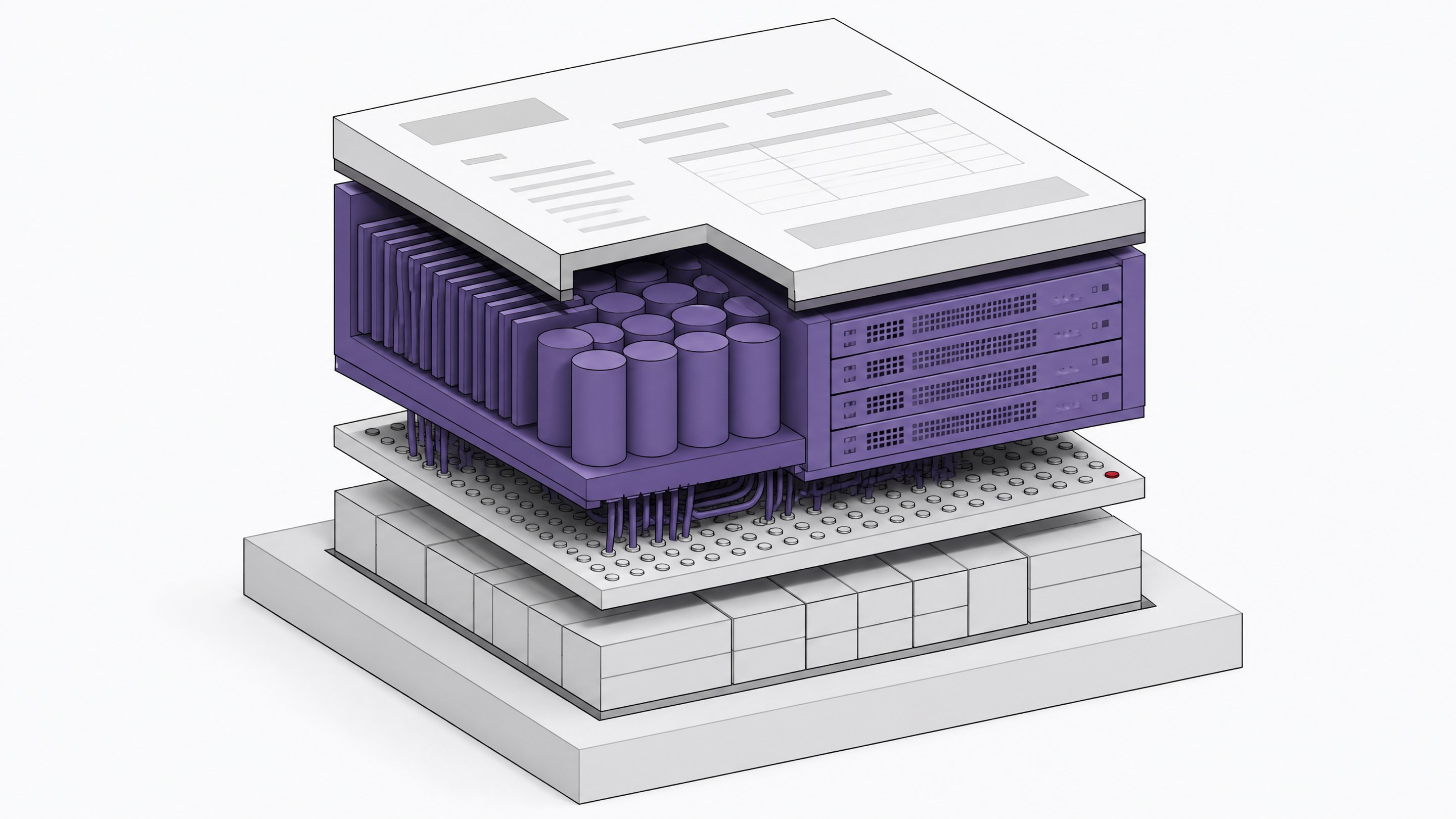
SaaS costs are increasing because vendors are passing three converging cost shocks straight through to subscribers: rising data-center electricity costs tied to AI buildouts, regulatory changes that shift those costs onto public utility ratepayers, and bot-driven waste in the ad-funded internet that inflates vendor acquisition costs. All three get bundled into your renewal as an "AI tier" or "platform fee," whether or not you use the AI feature at all.
The number that should worry every finance team
| Annual Cost | Control Over Roadmap | Maintenance Burden | Time to Deploy | Vendor Lock-in Risk | |
|---|---|---|---|---|---|
| Traditional SaaS (e.g., Salesforce contract)teams without existing engineering capacity | $40,000/yr | Low | Low | Immediate | High |
| RecommendedCustom AI-built tool (e.g., Lovable)teams with existing engineering capacity | $1,200/yr | High | Medium | Weeks | Low |
SaaS pricing rose roughly 11.4% year-over-year in 2025, against a G7 average inflation rate of 2.7%.1 That's not a rounding error. It's SaaS costs climbing four to five times faster than the general price level, and it shows up across the market, not in one outlier vendor. Gartner-tracked data confirms subscription costs from several large vendors rose 10% to 20% in 2025, well ahead of the 2.8% IT budget growth most finance teams had planned around.2
The per-employee math tells the same story. Average SaaS spend hit about $9,100 per employee by the end of 2025, up from $7,900 in 2023, a nearly 15% climb in two years.3 SaaS now eats roughly $1 of every $8 an organization spends.3 None of this tracks a matching rise in what these tools actually do for the average seat. It tracks something upstream.
What's driving SaaS price increases?
Strip away the marketing copy and three real cost pressures explain the gap between SaaS inflation and general inflation:
- AI compute and power costs. Running the AI features vendors are bundling into every tier requires data-center capacity that is getting more expensive to build and run, not less.
- Regulatory cost-shifting. Policy changes aimed at protecting data-center operators from bearing their own infrastructure costs have pushed those costs onto the public electricity grid instead.
- Bot and invalid-traffic waste. The ad-funded internet that SaaS vendors depend on for customer acquisition is soaking up billions in wasted spend on fraudulent and automated traffic, a cost vendors recover somewhere else in the business.
None of these show up as a separate line item on your invoice. They show up as "AI innovation" pricing.
Data centers: the pollution rules just got looser, and someone still pays
In 2026 the EPA issued guidance exempting "islanded" power plants that serve only data centers, not the public grid, from Clean Air Act acid rain requirements. The stated rationale was protecting consumer electric bills while the country pursues AI infrastructure dominance.
Electricity bills went up anyway. U.S. residential electricity prices rose 6.9% to 7.4% year-over-year in 2025, more than double the headline inflation rate of 2.9%.4 Goldman Sachs attributes 40% of the growth in electricity demand to data centers, and expects prices to keep rising above the inflation rate through 2027 and 2028.4 Data centers consumed more than 4% of U.S. electricity in 2023, and government analysts project that climbing to as much as 12% within three years.5
Big Tech has responded by becoming an energy company on the side. Subsidiaries of Amazon and Google have sold more than $2.7 billion on the wholesale electricity market over the past decade, building and selling their own generation capacity to keep up with data-center demand.5 Globally, data-center electricity demand jumped 17% in 2025, nearly six times faster than the 3% growth in overall global electricity demand, and the IEA expects AI-focused data-center power use to triple by 2030.6 The capex behind that surge from five large tech companies topped $400 billion in 2025 and is set to rise a further 75% in 2026.6
The clearest evidence of who eats this cost sits inside PJM Interconnection, the largest U.S. grid operator. PJM is paying power producers $16.1 billion for 2026-27 supply, a 10% increase, and its independent watchdog Monitoring Analytics attributes $23 billion of that cost growth directly to data centers, calling the resulting pass-through to consumers a "massive wealth transfer."4 Every SaaS product you run lives on a cloud server plugged into a grid like PJM's. When that grid gets more expensive, the vendor's hosting bill goes up, and your renewal follows. We've traced this mechanism in more depth in why AI infrastructure costs are driving up your SaaS bill.
The bot tax: bad traffic is inflating the cost of the internet SaaS vendors rely on
There's a second, quieter cost sink that rarely makes it into pricing conversations. SaaS vendors acquire customers largely through the same ad-funded internet everyone else uses, and that internet is drowning in fake traffic.
Lunio's 2026 Global Invalid Traffic Report, cited by the ANA, put global ad spend lost to invalid traffic at $63 billion in 2025, with an average invalid traffic rate of 8.51% across channels, nearly 1 in 12 clicks.7 The report expects that figure to grow further as AI-agent traffic increases.7 Imperva's 2025 Bad Bot Report found that bad bots alone now account for 37% of all internet traffic, the sixth consecutive year of growth, increasingly built and operated using AI.8
That waste doesn't disappear. It raises the real cost of every dollar a SaaS vendor spends acquiring a customer through digital ads, and it inflates infrastructure costs for any product that has to serve, filter, or defend against bot traffic at scale. Vendors don't itemize this on your bill either. It gets folded into the same cost base that justifies a renewal-time price increase.
How vendors are passing it down: the AI bundling playbook
The mechanism is consistent across the market: raise the list price, attach it to an AI feature launch, and let the AI narrative absorb the blame or credit, depending on the audience.
- Salesforce raised Enterprise and Unlimited Edition list prices by an average of 6% effective August 1, 2025, while introducing Agentforce add-ons starting at $125 per user per month and full Agentforce 1 Editions starting at $550 per user per month.9
- Slack, a Salesforce product, pushed its Business+ plan up 20%.1
- HubSpot, Atlassian, Microsoft, Google, Adobe, and Zendesk all raised prices between 5% and 30% in 2025, each citing AI investment as the justification.1
The framing matters. SaaStr's analysis found that 60% of vendors deliberately mask rising prices, and a majority do it specifically through AI bundling.1 Zylo's 2026 SaaS Management Index found the same pattern from the buyer's side: 79% of IT leaders hit a price increase at renewal in the past 12 months, often through mechanisms that never touch the sticker price at all, credit multiplier changes, forced seat-model migrations, and feature "shrinkflation" where capabilities included in your current tier get reclassified into a higher one. Organizations are carrying an average of $19.8 million in annual license waste as a result. We broke down where that waste actually accumulates in the 2026 SaaS waste breakdown.
Is this really about AI costs, or about margin?
Here's the complication. If AI infrastructure costs were the whole story, you'd expect efficiency gains to eventually show up in pricing. Some do. The IEA's own data shows per-task AI efficiency improving even as total industry power demand and capex balloon, because the volume of AI usage is growing faster than the efficiency gains can offset.6
That's a real cost story. But it doesn't fully explain vendor behavior. Gartner and Zylo's data shows vendors are using the AI narrative opportunistically, not just defensively. Sticker-price hikes tied to AI launches often land on customers who have not adopted the AI feature and have no plan to.2 A 6% list-price increase applied to every Enterprise seat, whether or not that seat ever touches Agentforce, is not a pure cost pass-through. It's margin expansion wearing an AI costume. The honest read: AI infrastructure economics created the opening, and vendors walked through it further than the underlying costs required.
What this means for your stack: rent vs. own
The part vendors are not counting on is that the same AI wave inflating their costs is also collapsing the cost of building software yourself. AI coding agents have pushed the build-versus-buy break-even point down to roughly $2,000 a month in SaaS spend for companies with existing engineering capacity. Atonom, an AI startup, replaced a $40,000-a-year Salesforce contract with a custom CRM built on Lovable that costs about $1,200 a year including hosting.10
The market is starting to price this in. Gartner projects 35% of point-product SaaS tools could be replaced by AI agents by 2030, and an early-2026 repricing event, dubbed the "SaaSpocalypse," wiped roughly $285 billion off software stock valuations as investors began accounting for the structural threat to per-seat pricing.10 For teams looking to escape platform lock-in altogether, the calculation gets sharper once you factor in what switching or exit actually costs, which we covered in the hidden toll of SaaS lock-in.
This is the practical response to an AI-bundled renewal notice: run the build-vs-buy math on any commodity SaaS line item where the AI markup exceeds the value you actually use. Teams evaluating that math against a rented AI stack are increasingly looking at platforms like Remy as the ownership alternative to another per-seat AI tier.
The bottom line
SaaS costs are rising 4 to 5 times faster than general inflation because vendors are routing two real cost shocks, higher data-center power costs pushed onto the public grid and ad-ecosystem waste from bot traffic, straight into subscriber bills, dressed up as AI feature launches. Some of that pass-through reflects genuine cost pressure. A meaningful share of it is margin expansion that the AI narrative makes easier to justify at renewal time. Either way, the fix is the same: stop assuming every renewal hike is unavoidable, and start pricing the alternative of building it yourself.
Key numbers for the record:
- SaaS pricing rose 11.4% year-over-year in 2025 versus 2.7% G7 inflation.1
- Average SaaS spend per employee hit $9,100 by end of 2025, up from $7,900 in 2023.3
- U.S. electricity prices rose 6.9% to 7.4% in 2025, more than double headline inflation.4
- Data centers account for 40% of U.S. electricity demand growth, per Goldman Sachs.4
- $63 billion in global ad spend was lost to invalid traffic in 2025, an 8.51% average invalid rate.7
- Bad bots made up 37% of all internet traffic in 2025.8
- The build-vs-buy break-even for replacing SaaS with an AI-built tool now sits around $2,000/month.10
SaaS pricing rose about 11.4% in 2025 while general G7 inflation ran near 2.7%. The gap traces to rising data-center electricity costs tied to AI infrastructure, regulatory changes that shift those power costs onto public ratepayers, and bot-driven waste in the ad-funded internet, all of which vendors recover by bundling price hikes into AI feature launches at renewal.
Both are true. Rising electricity and infrastructure costs behind AI features are real. But data from Gartner and Zylo shows many price increases land on customers who never use the AI feature at all, which suggests vendors are also using the AI narrative for margin expansion, not pure cost recovery.
SaaS products run on cloud infrastructure plugged into the same power grids as AI data centers. As data centers drive up wholesale electricity prices and grid operators like PJM pass those costs to ratepayers, cloud hosting gets more expensive, and vendors fold that increase into subscription renewals rather than itemizing it.
Invalid traffic is bot, fraud, and non-viewable ad activity that wastes digital ad spend, roughly $63 billion globally in 2025. Since SaaS vendors acquire customers largely through digital ads, this waste raises their real customer acquisition cost, a cost that eventually gets recovered through subscription pricing.
For commodity tools, increasingly yes. AI coding agents have pushed the build-vs-buy break-even to around $2,000 a month in SaaS spend for teams with engineering capacity, and real cases like a company replacing a $40,000-a-year Salesforce contract with a $1,200-a-year custom build show the math is no longer theoretical.
- 1The Great SaaS Price Surge of 2025: A Comprehensive Breakdown of Pricing IncreasesSaaStr
- 22026 SaaS Pricing Trends Driving Up Enterprise CostsZylo
- 3Download the 2026 SaaS Inflation IndexVertice
- 4Electricity prices rising by double the rate of inflation. Data center demand means no relief ahead, analysts sayCNBC
- 5Big Tech's A.I. Data Centers Are Driving Up Electricity Bills for EveryoneThe New York Times
- 6Data centre electricity use surged in 2025, even with tightening bottlenecks driving a scramble for solutionsInternational Energy Agency (IEA)
- 7Report: Ad Spending Wasted on Invalid Traffic Reaches $63 BillionANA (Association of National Advertisers)
- 82025 Imperva Bad Bot Report: How AI is Supercharging the Bot ThreatImperva (Thales)
- 9Updated Product Packaging and Pricing Offer New AI Capabilities and More Ways to Scale AI Throughout Every OrganizationSalesforce Newsroom
- 10Build vs. Buy AI for Tech Companies: When the Math ChangesHire Fraction