What Is AI Persistent Memory?
Every AI coding agent forgets everything the moment your session ends. Persistent memory fixes that, and it's quietly becoming the most important piece of infrastructure under any internal tool you actually plan to keep.

- 01Context windows act like finite RAM, and stuffing them with tokens increases both costs and latency.
- 02AI models struggle to retrieve facts buried in the middle of long prompts, regardless of window size.
- 03Persistent memory saves facts to external storage and retrieves only relevant data for each prompt.
- 04Specialized memory architectures can more than double an AI agent's accuracy on long-horizon tasks.
- 05Internal AI tools with persistent memory require governance to secure sensitive institutional knowledge.
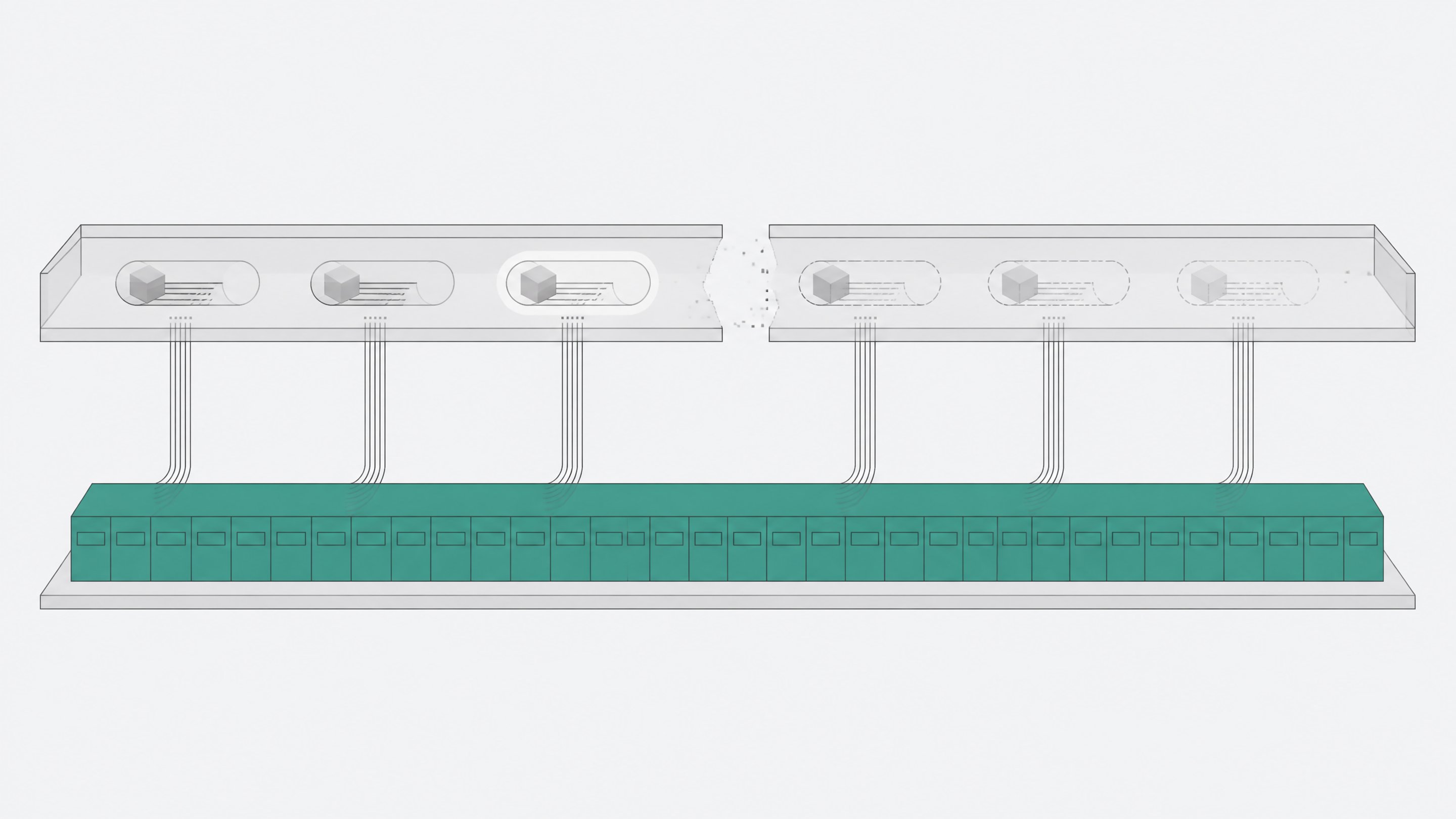
AI persistent memory is a durable, external store of facts, decisions, and history that lives outside a model's context window. Instead of cramming an entire conversation transcript back into the prompt every turn, an agent writes what it learns to that store and reads back only the relevant slice when it needs it. That's what lets an agent survive across sessions, restarts, and even a change of tools.1
That sounds like a small distinction. It isn't. It's the difference between an agent that behaves like a smart intern who quits every night and one that actually accumulates institutional knowledge.
Why do AI agents forget everything?
A context window is an LLM's working memory. It's finite, and every token in it costs money and latency. Treat it like RAM, not like a hard drive.
When a session runs long, something has to give. Anthropic's own documentation describes what happens inside Claude Code: as a conversation approaches its context limit, the system runs automatic "compaction," summarizing older messages into a shorter block so the session can keep going.2 That summarization step isn't free. It requires an extra sampling pass, which adds to your bill, and it can quietly drop details that only ever existed in the earlier chat.3
Worse, even models with huge context windows don't use all of it evenly. The "Lost in the Middle" study out of Stanford and Berkeley found a U-shaped performance curve: models are good at using information at the very start or end of their input, and significantly worse at retrieving something buried in the middle, even in long-context models built to handle exactly that.4 Stuffing more history into the prompt doesn't guarantee the model will actually use it.
The failure mode internal tool builders actually hit
This isn't theoretical. It's the daily texture of building anything with Cursor, Claude Code, or a similar agent. One developer described it plainly on Reddit: they spend an hour explaining the team's architecture to Cursor, and the next day, in a fresh session, they're explaining it all over again. Re-explaining the same context every single day was, in their words, getting ridiculous.5
That pain compounds across a team. Context that lived in one developer's head, or one chat session, doesn't transfer to the next person or the next tool. Multiply that by every internal app your team has quietly built with AI, and you get a fleet of tools that each restart from zero, over and over, at real cost.
How persistent memory actually works
Most real implementations follow a write path and a read path.16
- Write path. Every message, decision, or business event gets logged to a durable store. This is often a graph or structured database, not just a flat transcript.
- Extraction. Raw conversation gets distilled into facts, entities, and relationships worth keeping, rather than storing everything verbatim.
- Read path. Before the agent replies, the system retrieves a compact, relevant context block, not the full history, and injects only that into the prompt. Zep, for example, targets sub-200ms retrieval for this step.1
The result is an agent that behaves as if it remembers everything, while the actual prompt it sees each turn stays small and cheap. This is closely related to the cost problem covered in what is agentic context management: the model isn't what's expensive, the context you feed it is.
What are the main memory architectures?
There's no single "the" architecture for persistent memory. A few approaches dominate:
- Vector stores. Text gets embedded into high-dimensional vectors and retrieved by similarity search, acting like an associative memory. Vector stores are the most common long-term memory implementation, but they struggle with structured, multi-hop relationships, which is why hybrid systems increasingly pair vector search with knowledge graphs (GraphRAG).76
- Knowledge graphs. These track entities and their relationships over time, which handles the kind of temporal, multi-hop reasoning vector similarity alone misses.
- MemGPT's OS-inspired hierarchy. The foundational 2023 research proposed "virtual context management," borrowed from operating systems: data moves between a small, fast "main context" (the prompt) and large, slow external storage, giving the LLM effectively unbounded context despite a small window.8
- Plain files. In a 2025 benchmark, Letta found that agents storing conversation history in ordinary files scored 74.0% on the LoCoMo long-memory benchmark using gpt-4o-mini, beating several specialized memory and vector tools.9 The lesson: memory quality depends more on how an agent manages and retrieves context than on which storage technology sits underneath it.
A newer 2025 paper, Hindsight, pushes this further by organizing memory into structured networks of facts, experiences, summaries, and beliefs. It lifted long-horizon accuracy from a 39% full-context baseline to 83.6% on one open-source backbone, and up to 91.4% on LongMemEval and 89.61% on LoCoMo after scaling the model.10 That's the size of the gap between naive "just keep more context" approaches and systems built for memory specifically.
It's also worth being precise about what memory isn't. Retrieval-augmented generation (RAG) is read-only: it retrieves by semantic similarity but can't update or reconcile facts. If a user tells an agent they've switched from Python to TypeScript, a standard RAG setup just adds a new chunk alongside the old one, with no way to resolve the conflict.11 Real persistent memory needs to write, update, and track what's current, not just retrieve what's similar.
Why not just use a bigger context window?
This is the obvious objection, and it deserves a straight answer. Claude's context window now runs to 1,000,000 tokens.12 Why not just let the model hold everything?
| Multi-hop reasoning | Setup complexity | Benchmark evidence | Ecosystem maturity | |
|---|---|---|---|---|
| Vector storessimilarity-based recall of unstructured text | Low | Low | Most common long-term memory implementation | High |
| Knowledge graphs (GraphRAG)temporal, multi-hop entity relationships | High | High | Handles relationships vector search misses | Medium |
| MemGPT OS-inspired hierarchyunbounded context via tiered storage | Medium | High | 2023 foundational virtual context management research | Medium |
| RecommendedPlain filessimple, low-overhead conversation logging | Low | Low | 74.0% on LoCoMo with gpt-4o-mini, beating specialized tools | Medium |
Three reasons this doesn't hold up:
- Cost and latency. Bigger context means more tokens processed on every single turn, even the ones that don't need most of that history.
- Compaction still happens. Long sessions still hit limits eventually, triggering the same summarization and detail loss described above.23
- Restarting is expensive too. Practitioner discussion on Reddit around Claude Code's 1M window points out that staying in one long session can be cheaper thanks to prompt caching, but starting a fresh session means re-sending previously-established context at full price, with no caching discount.12
And even inside a massive window, the "Lost in the Middle" degradation still applies: a bigger haystack doesn't fix the needle problem.4 Persistent memory isn't a workaround for small context windows. It's a complementary layer that keeps the right information reachable regardless of window size, in a way that's related to the ideas in what is AI world modeling about giving agents a durable sense of state rather than just a longer transcript.
Why this matters for internal tools specifically
Here's where this stops being a research curiosity and becomes a governance question. Employees are already wiring memory directly into the tools they build for themselves. One security researcher documented a dev container with a pre-configured memory MCP (Model Context Protocol) server running alongside Claude Code, retaining context across sessions, routing through a company-hosted gateway, and invisible to the enterprise security stack the whole time.13 It's a pattern that shows up across the broader shadow AI stack employees are assembling without IT ever seeing a ticket.
That's the shift internal tool owners need to sit with. A stateless script that calls an LLM and returns an answer is easy to reason about. An agent with persistent memory has state: it knows things, it remembers decisions, it may hold sensitive context about your architecture, your customers, or your roadmap. That state has to live somewhere, and someone has to own the question of what's stored, where it's stored, who can read it, and how long it persists.
If your team is going to keep an internal AI tool rather than throw it away after the demo, memory infrastructure is what makes it reliable enough to trust: an agent that doesn't need re-onboarding every session, and doesn't quietly leak decisions into an ungoverned store nobody's watching. Platforms like Remy are built around exactly this idea: internal tools deserve the same durable, ownable infrastructure as any other system you'd put your name on, not a one-off script running memory nobody signed off on.
The bottom line
Persistent memory is durable, external storage of what an agent has learned, retrieved on demand instead of re-fed into the prompt every time. It's what separates an agent that starts from zero each session from one that actually gets better the longer you use it. As internal, employee-built AI tools multiply, memory stops being a nice-to-have feature and becomes core infrastructure, the same way a database or an auth system is core infrastructure. You don't get to skip owning it just because nobody in IT asked for it.
It's a durable, external store of facts and decisions that an AI agent can read from and write to across sessions, so it doesn't forget everything the moment a conversation ends or the context window fills up.
No. A bigger context window just holds more raw text in the prompt, which costs more and still suffers from retrieval degradation in long inputs. Persistent memory stores information outside the prompt and retrieves only the relevant slice when needed.
Not quite. RAG is read-only and retrieves by similarity, but it can't update or reconcile facts that change over time. Real persistent memory needs to write, update, and resolve conflicts, not just fetch similar text.
Not necessarily. Vector stores are common, but a 2025 Letta benchmark found agents storing history in plain files scored competitively against specialized memory tools, suggesting retrieval strategy matters more than the underlying storage tech.
Because memory turns a stateless script into a system that holds state, often sensitive state about your architecture or roadmap. That state needs an owner, which makes memory a governance issue, not just a technical feature.
- 1How to Give Your AI Agent Memory That PersistsZep (getzep.com)
- 2Compaction — Claude Platform DocsAnthropic
- 3Claude Code /compact: What It Does, What Survivesokhlopkov.com
- 4Lost in the Middle: How Language Models Use Long ContextsarXiv (Stanford/Berkeley)
- 5How are you handling persistent memory across multiple AI agents?Reddit r/AI_Agents
- 6The Architecture of Remembrance: Architectures, Vector Stores, and GraphRAGMem0
- 7How to Build an AI Agent with Persistent Memory Using RAG and Vector SearchMindStudio
- 8MemGPT: Towards LLMs as Operating SystemsarXiv (UC Berkeley)
- 9Benchmarking AI Agent Memory: Is a Filesystem All You Need?Letta
- 10Hindsight is 20/20: Building Agent Memory that Retains, Recalls, and ReflectsarXiv
- 11Beyond RAG: Why AI Agents Need Long-Term Memory, Not RetrievalXTrace
- 12Does the new 1M context window cost more in token usage for long Claude Code sessions?Reddit r/ClaudeCode
- 13How to Discover Shadow AI Agents in Your EnterpriseKen Huang / Agentic AI (Substack)