Reclaiming the Dev Cycle: Building an AI-Native Workflow You Actually Own
An AI-native development cycle is one where small local models and a lightweight local database replace ad hoc AI tool sprawl, so your team keeps the speed without shipping your codebase to a dozen unmanaged vendors.
 Written by Dana WhitfieldEdited by Luis Chavez-Mattos·Aug 28, 2026·6 min read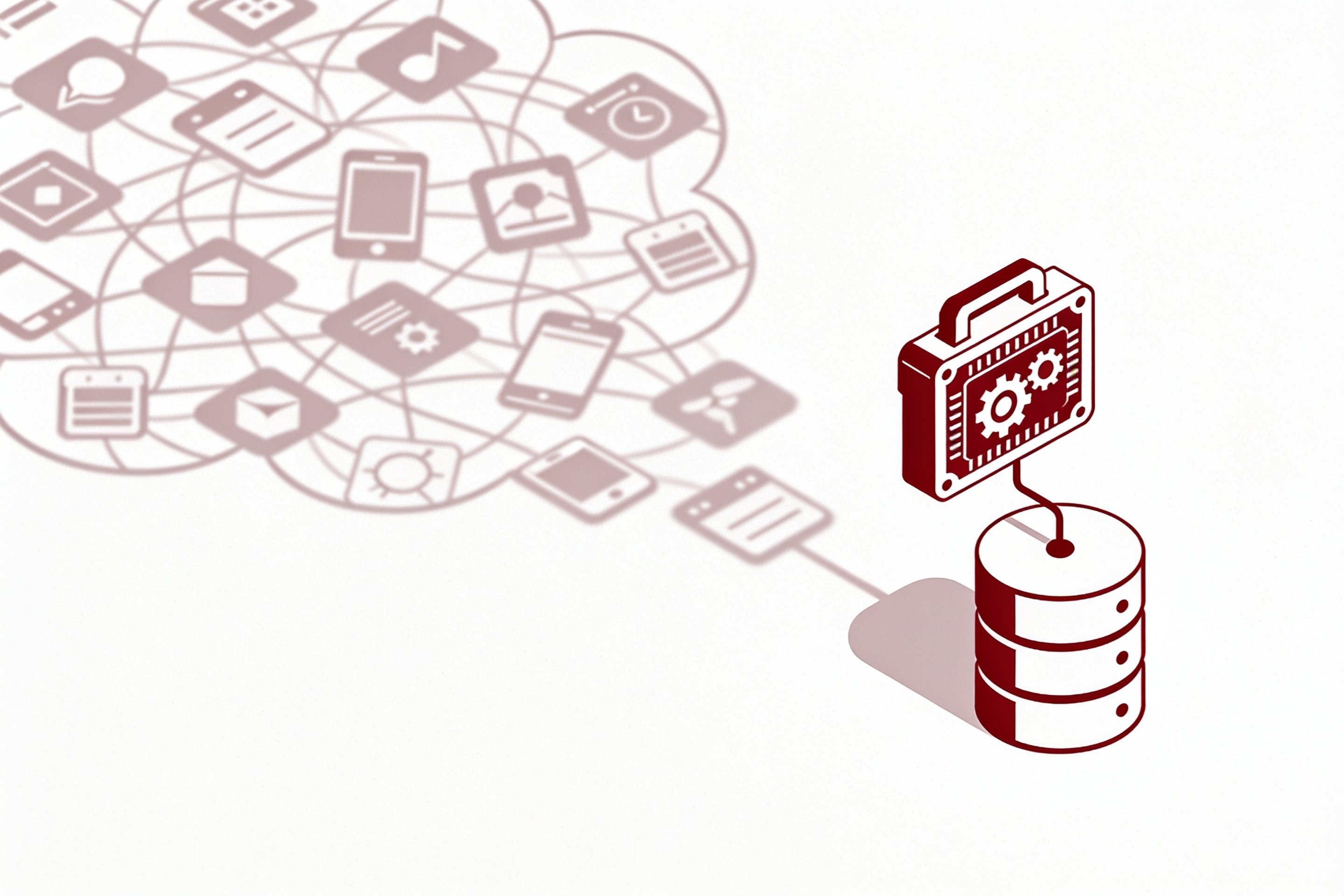
The short answer
An AI-native development cycle is a standardized loop where AI assistance is built into your own infrastructure, using small local models and a local-first data layer, instead of employees quietly wiring together whatever consumer AI tool solved their last problem. It looks less like "everyone has ChatGPT open" and more like a pipeline: a compact model does a defined job (finding vulnerabilities, drafting tests, summarizing diffs), a local database logs what it did, and the whole thing runs on infrastructure the company controls.
Most companies already have the ingredients for shadow AI chaos. They just haven't assembled the alternative.
The problem you already have, whether you've measured it or not
Shadow AI is not a fringe issue anymore. Some 98% of organizations have employees using unsanctioned apps, including AI tools, and roughly three-quarters of businesses now have active bring-your-own-AI usage running through their workforce.1 Daily AI use among employees doubled in one year, from 4% to 8% between June 2024 and June 2025, and frequent use (a few times a week or more) grew from 11% in 2023 to 19% in 2025.1
The catch: usage outpaced governance. Only 30% of US employees say their company has any formal AI use policy, and 58% report receiving no training on safe AI practices at all.1 That gap is not free. IBM's 2025 breach research found that organizations with high levels of shadow AI saw breach costs rise by $670,000 on average, a 16% jump versus organizations with low or no shadow AI use, and 97% of AI-related breaches involved a lack of proper AI access controls.1
A separate UpGuard survey of 500 security leaders and 1,000 employees found 81% of employees and 88% of security leaders admit to using unapproved AI tools, and that blocking doesn't work: 45% of workers simply find a workaround when a tool is restricted.2 Training doesn't fully fix it either. Even among employees who recall AI training, 40% still use unapproved tools daily.2
The pattern is consistent: banning AI pushes it underground. Employees aren't malicious, they're impatient. The fix isn't more restriction. It's giving them a faster, sanctioned path that happens to be one you can actually see.
Why "AI-native" doesn't mean "cloud-dependent"
Most people hear "AI-native workflow" and picture another SaaS seat: a coding copilot subscription, a vendor dashboard, a new invoice. That's not ownership, that's just adding a subscription to the shadow AI pile with better branding.
The alternative is smaller and more boring than it sounds: run purpose-built small models locally, store the outputs in a database you control, and treat the whole loop as internal infrastructure rather than a rented service.
Cisco's Antares family is a useful proof point for what "purpose-built and local" looks like in practice. Antares-1B is a 1-billion-parameter open-weight model built specifically to locate vulnerabilities inside a codebase, and it's compact enough to run on a workstation instead of shipping proprietary source code to a third-party cloud.3 Cisco's own benchmark shows the model family completing vulnerability localization runs at a fraction of the cost and runtime of larger general-purpose models, while outperforming many of them on the specific task it was trained for.3 As Reza Shokri, a computer science professor at the National University of Singapore, put it in Cisco's release announcement: "Small models are especially compelling here: they run locally, so proprietary code never leaves the machine, and they're fast enough to gate an agent's output in real time."3
That's the model of an AI-native cycle worth copying, not because every team needs a security-scanning model specifically, but because the shape generalizes. A narrow model, sized for one job, running where your code already lives, beats a general-purpose chatbot that requires your code to travel somewhere else first.
The four-stage loop
Here's a concrete, repeatable structure a mid-size engineering team can stand up without a platform team the size of Cisco's.
1. Ingest
Every commit, pull request, and test run gets logged to a local analytical database. DuckDB fits here because it's an embedded, in-process engine: no server to run, no separate infra bill, and it's fast enough to query gigabytes of commit history or CI logs directly on a laptop or a single CI runner. Instead of scattering logs across five SaaS dashboards, you get one queryable table of what your dev cycle actually did.
2. Route
Not every task needs a frontier model. Vulnerability localization, test scaffolding, changelog summarization, code review triage: these are narrow, well-defined jobs that small, task-specific models handle well at a fraction of the inference cost. Route the narrow jobs to small local models. Save the expensive general-purpose calls for genuinely open-ended reasoning.
3. Verify
This is the step shadow AI skips. A small model's output, especially a security-relevant one, needs a checkpoint before it lands in the codebase. That checkpoint can be another lightweight model pass, a rule-based static check, or a human reviewer, but it has to exist and it has to be logged in the same local database as everything else.
4. Audit
Because every step of stages 1 through 3 wrote to the same local table, you can query the whole cycle after the fact. Which model flagged which file. Which flags a human overrode. How long the loop took end to end. This is the part that shadow AI structurally cannot provide, because nobody logs what ChatGPT did in someone's browser tab.
What this actually solves that policy memos don't
Policy alone hasn't worked. IBM's research shows 63% of organizations have no AI governance policy at all, and even among the 37% that do, only 45% enforce a strict approval process for new AI deployments.4 Meanwhile the ISACA research on shadow AI notes that unauthorized tools "create silos that are often dangerous for enterprise risk management," citing a simple example: an employee running a personal Copilot subscription to generate production code, quietly creating an unmonitored information flow.4
An AI-native cycle built on local models and a local database removes the reason employees reach for outside tools in the first place. If the sanctioned workflow is faster and doesn't require an approval ticket, most people will just use it. If it's also cheaper to run than a stack of individual subscriptions, that argument sells itself to finance too. This is the same math that shows up across Software Ownership thinking generally: the tools you build and run yourself become assets on your balance sheet, not recurring line items you have to justify every renewal cycle.
FAQ
What does "AI-native development cycle" actually mean? It means AI assistance is embedded directly into your build, test, and review pipeline using models and data infrastructure your company runs and owns, rather than employees pasting code into consumer AI chat tools on their own initiative.
Do I need a giant model to do this? No. The Antares example shows a 1-billion-parameter model can outperform larger general-purpose models on a narrow, well-defined task like vulnerability localization, at a fraction of the inference cost and without sending code off-machine.3
Why DuckDB specifically? It's an embedded analytical database with no server to run, so it's cheap to add to any pipeline. It lets you log and query everything your AI-native cycle does, commit by commit, without standing up a separate data warehouse.
Isn't blocking shadow AI tools the simpler fix? The data says no. In the UpGuard survey, 45% of employees who hit a blocked AI tool simply found a workaround, meaning the block just cost the company visibility rather than usage.2
What's the actual cost of doing nothing? Organizations with high levels of shadow AI saw breach costs run $670,000 higher on average than organizations with low or no shadow AI use, a 16% increase.4
It means AI assistance is embedded directly into your build, test, and review pipeline using models and data infrastructure your company runs and owns, rather than employees pasting code into consumer AI chat tools on their own initiative.
No. Cisco's Antares-1B, a 1-billion-parameter open-weight model, outperforms many larger general-purpose models on the narrow task of vulnerability localization, at a fraction of the inference cost and without sending code off-machine.
It's an embedded analytical database with no server to run, so it's cheap to add to any pipeline. It lets you log and query everything your AI-native cycle does, commit by commit, without standing up a separate data warehouse.
The data says no. In UpGuard's survey, 45% of employees who hit a blocked AI tool simply found a workaround, meaning the block cost the company visibility rather than usage.
Organizations with high levels of shadow AI saw breach costs run $670,000 higher on average than organizations with low or no shadow AI use, a 16% increase, according to IBM's 2025 Cost of Data Breach Report.
- 1.Shadow AI Statistics: How Unauthorized AI Use Costs Companies — Programs.com
- 2.The State of Shadow AI - Trends, Insights & Statistics — UpGuard
- 3.Introducing Antares: Highly Efficient Open Weight AI Models for Vulnerability Localization — Cisco Blogs
- 4.The Rise of Shadow AI: Auditing Unauthorized AI Tools in the Enterprise — ISACA